Sunday, August 2, 2026


Growing up, Nancy Drew and the gang in the Mystery Machine taught me all I needed to know about plot lines.  Their stories helped me understand the concepts of an exposition, rising action, and climax, and the resolution always brought about a great sense of satisfaction.  After all, the bad guys were always caught, justice was always achieved, and “the meddling kids” were overjoyed at their victory.

Although I was never the type to peek at the last few pages of a book, predictability taught me what to expect, and I felt like Velma when I suspected the outcome.   The plot made sense.  The first half of the story led to the second half in logical sequence, even if the endings sometimes surprised me.  

However, what I was not ready for was real life.  I’m still not.

* * * * * * * *

I am still stumped and frustrated when the storyline of my life does not make sense.   It often feels as if the second half of the book has been torn away—-and another author took over and rewrote the ending that SHOULD have been there.   It seems as if pages that don't belong have been inserted in the wrong place.

Sometimes it also feels as if the book ends abruptly with no denouement, and with no explanation for why or how.   The first half of the book is loosely taped together with the ending of another book, with no explanation of how one led to the other.

Imagine the horror of Nancy not solving the mystery or of the Scooby Doo gang being falsely accused of the crime.   Perhaps even Velma or Daphne are killed by Cyrus Wheedly or Mr. Crink in episodes 13 or 23.

Yet, life is often like that.  I was fortunate perhaps to have lived many years before the second half of my book got torn away.  Perhaps the first unexpected narrative shift was in 1993 when my 52-year-old dad died suddenly of a massive heart attack.  All the plot details of his retirement, of time with his grandchildren, of my time becoming an adult and knowing my father as an adult were ripped away and destroyed.  He would never play peek-a-boo with my sons, or cheer at the state tennis tournament, or laugh with me at Chevy Chase’s antics in Christmas Vacation again.  

I was faced with two questions:  “Kim, what do you do when Dad's narrative just ends without warning?   When all his energy and drive ends up in a flatline?”

 As an English teacher—or as a human—I had to consider how this might work.  Is this a Part 2?  A different volume?  A rewrite of the original plot line?  A before-and-after plot?  Or was this the actual plot line all along?

It didn’t follow the English teacher plot diagram, so what did this mean for me as an English teacher who regularly teaches Freytag’s pyramid?

* * * * * * * * * * *

Obviously, my “happily ever after” ending has been rewritten and rewritten so many times since 1993  that I have no idea what my true ending will be.   At this point, I have gone through two marriages that ended violently and suddenly.  My boys, crushed by disappointments with the divorce, have distanced themselves.  My mother died early and suddenly, without much warning, and my list of supporting characters has emptied again and again.

Real life destroys typical plot narrative.  There are often few smooth transitions.   One event can completely destroy all the characters in the plot, and the protagonist is off on her own to restart a different story.  The innocent, naive 23-year-old who lost her father is not the same 34-year-old mom who went through a divorce or the same 54-year-old adult who greeted sheriff deputies at my front door at 3:00 a.m. to hear of Anthony’s death.  The  English teacher in me knows this means I am a round, dynamic character.

The person I imagined myself to be at this stage of life does not at all resemble the one who actually exists.  My life circumstances at age 57 are  also not what I imagined.    

* * * * * * * * * * * 

When the plotline suddenly explodes or implodes,  
when everything you knew about life is suddenly proven wrong, 
when reality buckles your legs and forces you to the floor, 
how do you keep on moving forward in the plot?   

When the clues have evaporated, and the supporting cast has disappeared,  and you are there suddenly not recognizing the setting or your motivation for being there, what comes next?

I don’t know.  
I don’t know how you move forward in the plot. 
 I don’t know how you begin Part 2 or the second half.

Many who know my story don’t understand how I kept going.  
Many ask me how I survived. 
I don’t know.

I just know that I kept putting one foot in front of the other. 

One second became two seconds became three.
One task became two tasks.
One decision became two, became three.

It doesn’t seem like strength when there are no other choices.

It seems like the next step.

The hard part is not breathing the next breath because it will come whether you want it to or not.
The hard part is accepting the second half of the story that has suddenly been thrust upon you.
The hard part is learning to love the new character that was forced into that second half.
The hard part is forgiving the old character who thought she had it figured out and didn’t see the huge explosion of the narrative.
The hard part is honoring all the parts of you from the first half you loved and then deciding what new parts need to be added.

Then, the next step is to gather the existing characters, whether it is just Bess and Ned, or maybe just Daphne and Scooby, and choose to keep on doing what you know to do next.  It won't be the same without the other characters, but you will keep breathing and moving and living, as much as you might wish otherwise.

The plot line will never look like what Freytag illustrated, or what I see in every Nancy Drew book or Scooby Doo episode.

However, there are still adventures to be had, bad guys to be discovered, and friendships to be made.  I have given up even trying to predict anything about the rest of my plotline.  There are just too many variables.  

* * * * * * * * *

What I have promised myself is to love myself in all the pages of the book, to treasure the moments that sparkle, and to be who I was meant to be all the way along, whether this book from here on out is more of a traditional plot line or resembles 5 parts all glued together.  

For a girl who fell in love with storylines early in life, I am trying to love my current setting and accept the rising action and the falling action as it comes.  Even this newest part of my story can be mine.  

I am climbing in the Mystery Machine with whoever wants to join and see what new mysteries await.  They may not all be fun or joyous, but I am in it until the end.   

I always did enjoy an interesting story.


Sunday, July 26, 2026

The Cask of Amontillado Revisited (or The Tale of an Abusive Relationship)


His eyes called me to him—

And his smile—

And, of course, his comforting presence and sweet words.


My friend, the one who knows me and wants only the best for me.

My friend offered me the sweetness of life 

if only I would love him and follow him to the secret places of his heart—

Secret places saved only for me.


The Amontillado—a precious, rare treasure saved only for the most special—

The most Fortunate. 

Me.

He told me I was lucky to have him and to share in what he called “My Treasure.”


I left others behind, my friends and family, to join him, to follow him step by step.

That one decision led to many others,

Winding,

Confusing,

Desolate.


I lost my way . . .

My sense of direction gone, the light dim,

All I knew to do was to follow him—

he who was confident, reassuring, and promising.


I followed the light and hope of his words . . . 

Even as a small part of me longed to go back,

To find my own way, to trust my own sense of direction.


His sweet words “love-bombed” me, exploding my fears and worries.

He spoke of his concern for my well-being, my health, my happiness.

Even as I felt something was wrong, 

I not only believed in him, but I believed him.  

His directions of up and down, right and left, right and wrong became mine as well 

as he guided me through the chaotic corridors.


He promised the treasure was just ahead . . . 

And I stepped hopefully, with purpose . . . 

Only to find a dead end.


It was too late.

Chains bound me in a special “cage” created just for me by him,

A Goldilocks-perfect trap created by one who knew me so well,

Who knew now how to weaken me,

To make me beg and plead,

To play with my insecurities,

To force me to cajole, make promises, accept unnecessary blame,

Become someone I barely recognized because I barely recognized him..


My pleas only led to gaslighting, to mimicking, to mocking jeers.

“I will destroy you,” he cackled, as my knees buckled beneath me.

“You changed.”

“You made a fool of me.”

“You made me do this.”

“I wouldn’t have done this if you hadn’t forced me to.”

Nemo me impune lacessit.”


He played with my hopes,

As he bricked me in,

Block by block,

The outside world slowly dimming,

The refreshing, rejuvenating sustenance thinning,

To be replaced by his toxic cheer and lies.


He sat outside the wall of his making, enjoying my pain,

Content to go about his life, making up stories to others,

Altering reality.


As I struggled against the chains, I asked myself, 

“How could you have been so blind?”


I saw now the true irony.


He had said if I followed him I would find the treasure, and in an odd way, it's true.

Only now did I see, as I sit cramped in this tiny spot,

I did find the only real treasure --- ME.

There was no treasure he could offer me.

Instead, I had been the real treasure the whole time,

Valuable beyond measure,


And now he had ME, trapped for his pleasure.


Sunday, May 31, 2026

Dumpster-Diving Granny (and some road pickles)


From the windows of my grandfather’s beautifully buffed behemoth of a car, a 1975 Lincoln Continental, my sister and I gradually sank lower and lower in our seats, hoping no one saw us—

Embarrassed,
Horrified,
Exasperated.

Just outside the windows we could see them—Mom, Dad, Grandma, and Grandpa—standing beside a dumpster at the Asheville Farmers’ Market.

We saw my mom helping to lift my 75-year-old grandmother to the upper edge of the dumpster, her butt in the air, hovering over the edge to grab left-behind cantaloupes, all perfectly ripe, the last of a farmer’s load to sell, abandoned at the end of a long selling day.

My grandmother, all 5’ 1” of her, and her daughter, my mother, raised to be just as determined, just as frugal, grabbed one and hoisted it to my grandpa who acted like this was an everyday occurrence.  Grabbing another and waving in the air, Grandma yelled to us and pointed, “Look, girls, they’re perfect.  We’re having cantaloupe tonight!”

Both Kelly and I sighed and knew that anyone driving by who noticed an old lady dumpster diving in her polyester culottes and shirt would find this a curious sight.

* * * * * * * * *  

Years later on Hwy. 37 in the boonies, halfway between Bradenton and Mulberry, Florida, not a car in sight, once again, Kelly and I sank in the back seat, watching Mom and Dad scurry across the two lanes of highway, picking up cucumbers that had fallen from a produce truck, packing them into the trunk of our VW Rabbit.  

“Waste not, want not” rang in our ears.  When Mom exclaimed, "Girls, they are the perfect size!" we instantly knew all evening plans, including the weekly watching of Heehaw and The Lawrence Welk Show,  would be sidetracked to sanitize Mason jars and can some pickles.

Like mother, like daughter.

* * * * * * * * * *

Grandma’s early adult years were spent in the Great Depression, so frugality was treasured, and became a commodity of its own.

50 years later, that commodity led to a dumpster diving granny and road pickles and a cabbage incident.  There I stood in a Florida Publix watching Grandma strip layers of cabbage leaves off the head before weighing it for the price, proclaiming to me as I hid my face behind my collar, “Why should I pay for the cabbage I won’t use?”


* * * * * * * * * * *

Only age provides clarity.  Imagine my wonderment as I now consider these two influential women.

Both were proud money-savers, 
garage sale junkies, 
discount rack-only customers.

Yet despite this frugality,  neither saved, 
scrimped, 
or hoarded their love, 
their time, 
or their praise.

The young, embarrassed sixth grader wouldn’t have recognized this irony,
Wouldn’t have appreciated the generosity,
But I do now.

Perhaps part of being a mom involves—
The pursuit of seeing the traits our kids devalue and toss aside,
The desire to uncover the hidden value,
The willingness to throw dignity aside and dive into the mess,
Come up to the surface,
And hold high,
Pointing and yelling at all who pass by, 
“Hey, look at what I found.”

Wednesday, December 31, 2025

Who Cares? A Wish for 2026


 The unbelievable surrounds us . . . . 
The intricate weaving of scraps to make a bird nest,
The maze of tunnels in an ant kingdom,
And the thrumming beat of the hummingbird wings as it drinks from an open flower.

But perhaps the most astounding, the most miraculous, is when a human decides to stop and
Notice the lives of others,
Listen to their stories,
Step into their shoes,
And imagine their hardships.

You know those who do this.  
They are the ones who are often criticized for their bleeding hearts.
The weight they carry for others is heavy.

Horton from Dr. Seuss’ Horton Hears a Who! knows all about this.  As large as this pachyderm is, he hears the tiny sound of a voice on a speck of dust, a voice no one else hears.  Despite the cackles of the sour kangaroo and her babe, and despite the resistance of the Wickersham Brothers and the black-bottomed bird, Vlad Vlad-i-koff, he cares for the speck of dust and the people of Whoville.

In case you didn’t know, Dr. Seuss’ early work contains many racist stereotypes and contributed to American mistrust of Japanese-Americans during World War II.  However, his character Horton reveals that he, too, stopped and listened.  He, too, underwent a change of heart.  He, too, developed a willingness to hear the voices of those in Japan, to deal with the criticism of others, and to care.

It takes integrity to refuse to use our power and position, our large Horton size, to assert our desires—-but instead, use our position to protect those who may not “measure up” in our eyes.  

It takes courage to protect the powerless, the poor, those who are different from us.

It takes grace and mercy to see the humanity of others whose views and lifestyles don’t match ours.

It takes intentionality to look for those others, those citizens of Whoville, who believe their voices don’t matter, and encourage and enable them to speak.

* * * * * * * * * *

In 2026, I am hoping for a miracle—
For supervisors and bosses to listen to employees and care about their experiences,
For those in power to care about those little “specks of dust” and the people who inhabit them,
For us to look for those who need to be seen,
For us to hand a loud megaphone to those who need some help to be heard,
And for the voices of all of us in our own little Whoville to make a loud “YOPP!” 

May we, like Dr. Seuss, the sour kangaroo and babe, and the Wickersham Brothers evolve and look for specks of dust and their inhabitants.   May we listen to their stories and their voices.

May we care for every Who . . . .

Monday, December 15, 2025

Choose Your Own Adventure---Robert Frost Style


Robert Frost's "The Road Not Taken": The Meaning You Never Knew Until ...

Choose Your Own Adventure
Robert Frost Style

A different interpretation of "The Road Not Taken" 


"Two roads diverged in a yellow wood,
And sorry I could not travel both
And be one traveler, long I stood . . ."


Adventure Choice 1:

I took the road more traveled.
While I wasn’t sure this was the right choice, 
the road was well-worn and familiar, 
As it was the path recommended to me by all I knew.

Each fork in the road was clearly marked,
And signs along the way let me know which way to go.
Smooth.
Rest stops and markers warned me how much longer the path would go.
Well paved.
Lights marking the way in the dark.
Companions along the way who appeared to care about my journey.

Yet, each step I took I felt less and less real
But instead, just marching in step with everyone else.
I was taking a path I knew would lead to a future clearly defined,
But I didn’t know if that was a future I wanted, 
But was it too late to turn back now?

Scared to undo all my walking, I regretfully moved forward with the crowd.  


Adventure Choice 2:

I took the road less traveled.
I wasn’t sure if this was the right choice,
And every indication proved I might be right.
Branches occasionally leaned into the walkway,
Forcing me into the loose pebbles along the way.
Potholes and tree roots populated the path.

The path seemed to dead end, and only with careful inspection,
To the right, I saw a small deer track,
Where these creatures had separated the grasses, matting their stalks into the mud.
I crouched and squat-walked under the tree limbs, uncertain the route.
Leaves stuck in my hair, and spider webs brushed my cheeks.

Darkness came, and only the moon highlighted the route, 
My companions the crickets and cicadas, coyote cries, and owl songs.
Alone, I wondered why I had taken this path.
Regret filled my heart.
I twisted my ankle on an unexpected rock.
Looking desperately around for a stick,
I hobbled forward, one painful step at a time.

It was true that on this path I was gloriously free to go my own way, 
that the lack of human companions allowed me to hear the wind dancing in the leaves,
but did I even know where the path was as it often was hidden?
Did I make the right choice?  It could make all the difference.


Adventure Choice 3:

I didn’t know which path to take.  
I sat with such indecision and fear that I would make the wrong choice
That, instead, I went back home and turned on Netflix.


Adventure Choice 4:

I didn’t know which path to take.
I was filled with indecision and fear.
I re-read Frost’s “The Road Not Taken.”  

I read the words in the last stanza:

I shall be telling this with a sigh
Somewhere ages and ages hence:
Two roads diverged in a wood, and I—
I took the one less traveled by,
And that has made all the difference.


I realized that no matter what road I took,
I might tell this with a sigh, with perhaps wonder about the other road.
Each choice may make all the difference—
Not because one was right and one was wrong, 
But because either path would make a difference in me,
Would alter who I was,
Would change the view of the world I had.


Regardless of the choice, I couldn’t see the future.
I couldn’t predict the difference it would make.
I could only do the best I could in this situation
And being confident in myself and my own ability to learn on any road,
I picked one—without guilt, fear, or concern that I was doing the wrong thing.
No regrets.  No second-guessing.
A decision to enjoy the present.

I skipped down the path, enjoying the yellow wood, 
Winding along,  
Following the moonbeams and stars when my path was unclear.

And that realization has made all the difference.


Monday, July 21, 2025

A Word Eater

How to Set a Formal Dinner Table

Because I was taught to be a sweet little girl,
Obedient and loving, putting others first,
Because I was taught “If you can’t say something nice, don’t say anything at all” and the familiar rhyme “sugar and spice and everything nice,”

Because of that, I learned early on to eat my words.

My baby teeth were still in, and I was learning the skill so many little girls are taught—
I learned to eat my words one word at a time. 
Noisily crunching, snapping, and chomping.
I was advised to be polite and “never talk with your mouth full,” but even with my mouth closed, my chewing sounds were so loud others could hear my eating.

Over the years I learned to break the words of pain and disappointment and outrage more slowly,
More carefully, so few noticed.
I deliberately ground those words into tiny pieces easy to swallow and digest,
So slowly and deliberately I felt like I was opening a peppermint wrapper in a quiet church service.

Later, as my molars came in, and as my wisdom teeth started making their way to the surface,
I learned how to eat my words less noticeably, more noiselessly,
Scissoring, grinding, and using my tongue to loosen lost bits of hurt and anger from my molars.
Few knew I was chewing—

I was even capable of smiling while I felt the words present between my cheek and teeth, moved aside for future examination because the words were too much,
Like a too-big acorn pocketed away in a chipmunk’s cheek.

In addition, I learned that the most dangerous words, the most gristly of all, were words of anger.
Sweet girls didn’t voice these weapons.
These words were quickly swallowed,  despite my pediatrician’s advice to chew 30 times to aid in digestion.
These words could not be liquefied, they could not lose their texture and gristle.
These words of anger had to be swallowed whole, and I felt them slowly move down my throat, down my esophagus, and further inside.

No wonder women gain weight in middle age.
Too many words swallowed.
Too many words gnawed on, chewed on, swallowed.
Whole minutes and months and years, perhaps, spent gumming words into a shapeless, tasteless mass,
A smushed denial of existence.
Swallowed and sitting in the stomach, in the blood flowing through our veins, and in our very being.
Filling us up,
Undigested,
Weighing us down,
Gurgling and bubbling from below,
Breaking down and burning, acidic, erosive,
With a great desire to expel them all . . . 

But knowing all too well that no one (including myself) is prepared to see just how many words we have eaten.


Saturday, July 5, 2025

Finding the Burden Stones


“We're born alone, we live alone, we die alone. Only through our love and friendship 

can we create the illusion for the moment that we're not alone.”  

Orson Welles

I was in early elementary school when I had one of the worst cases of the flu  I can recall.  I was running a high fever, was nauseous, had burning eyes, and could barely move.  I can remember Mom hovering over me while I lay with my eyes shut on the sofa, saying to me, “I would do anything to take this from you.  I wish it were me who was sick instead of you.” 

Although I was surrounded by loving family members, I alone had to suffer.  No one else could take it away from me, and no one else could feel that pain in that moment.  

Like Mom, over the years, I have offered a similar sentiment to my sick sons or to others going through difficult times, but I know that no words I provide to friends and family can take away the pain or transfer the heaviness to me.  As Orson Welles wrote, “We’re born alone, we live alone, we die alone.”

In 2020, as Mom lay on her hospital bed dying, she was not alone.  My sister, my niece, and I held her hands.  She was surrounded by love, but she alone went through that experience that all of us one day will encounter.  I couldn’t experience it with her or feel what she was feeling.

* * * * * * * * *

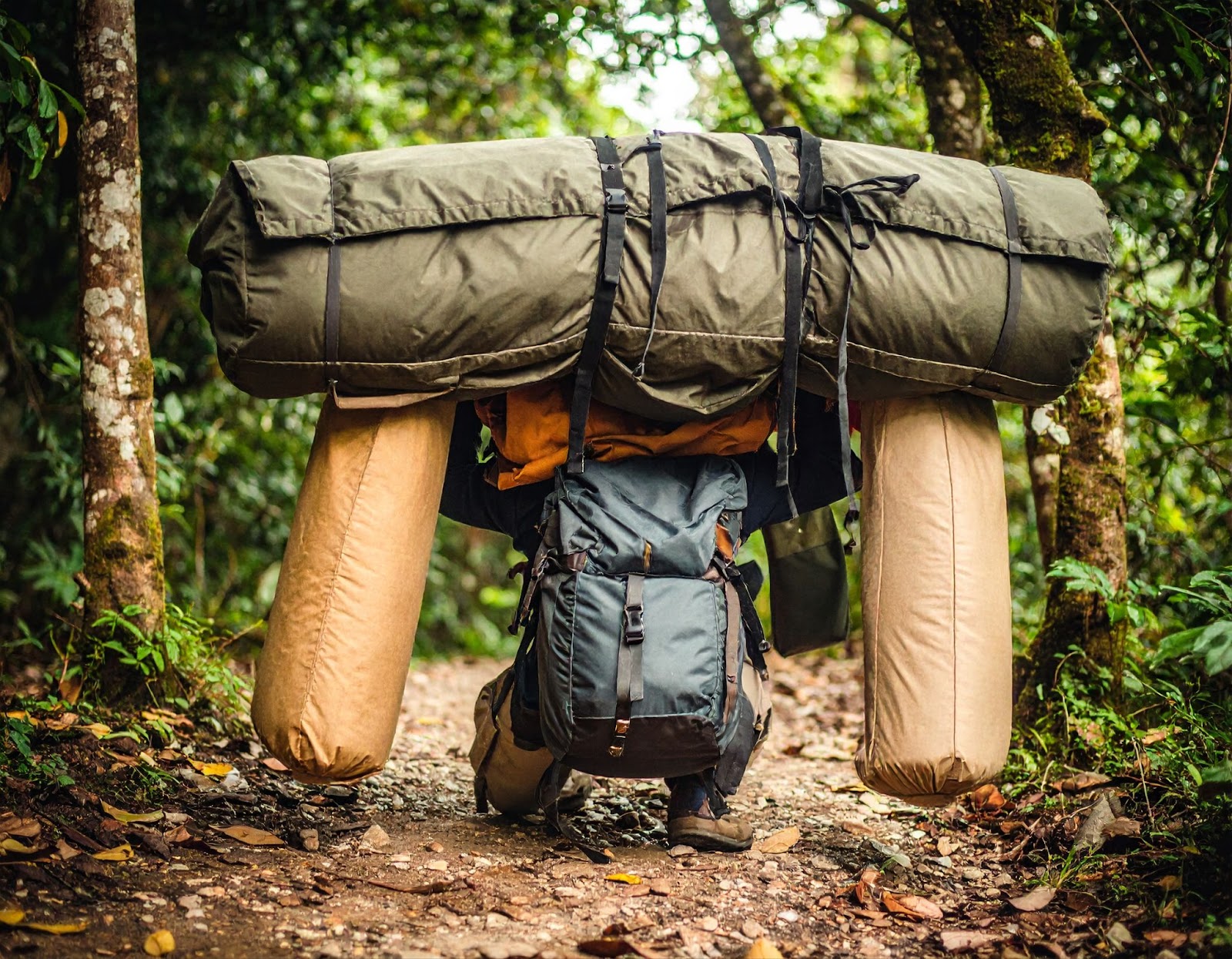
Fast forward to 2024.  I was in my car doing my usual—-dealing with semi-trucks on I-35 on the way to work and listening to an audiobook.  The book that day, The Covenant of Water, is a novel with a  setting of 1900 in south India, and within the first five minutes, my breath stopped.  I had to hit pause after hearing the narrator read, “A burden stone [was] a horizontal slab of rock at shoulder height held up by two vertical stone pillars sunk into the ground, a place for a traveler to set down a head load and catch their breath” (Ch. 2).  

It is true that this novel by Verghese has many motifs and symbols that perhaps only an English teacher would appreciate.  However, this sentence was not one that stood out to me because of my job.  I paused the audiobook because the need for a burden stone  seemed so relevant even outside of 1900 south India.  The need is true for all of us repeatedly in life.  The need is even more so in our current national and worldwide turbulence.

Verghese wrote that in this land “where most everything is transported [on their heads] along well-traveled footpaths, a rest station [like the burden stone was] a blessing” (Ch. 4).

* * * * * * * *

At least twelve months have passed since I listened to this audiobook, but the concept of a burden stone has rested in my soul.

So many of us carry heavy loads, burdens, guilt, shame, and unfulfilled longings.  The journey of life along footpaths that are only wide enough for one person at a time can be hard.  These burdens weigh on our souls, our hearts, our bodies, and definitely in our minds.  How fitting it is that Verghese was discussing a source of relief from the head load these travelers were carrying.

We all have a head load that needs to be offloaded for a short while.  We also probably have a heart load, a soul load, and a physical load that needs to be eased on heavy stones while we temporarily rest.

I found it significant as well that in the novel no one else comes along and carries that load after the characters have eased it onto the horizontal slab.  Instead, the traveler, once rested, picks up that load again and continues on.  That load is ours-–and ours alone.

* * * * * * * * * *

Life recently seems to be full of turmoil.  The news headlines daily add to my soul load, as my heart hurts for those whose lives are turned upside down.  It is hard to find a space to breathe between the “breaking news” alerts, the threat of war, and the stories of heartbreak.   For those of us with an abundance of empathy, our minds and hearts go to those frightened by changes in policies and by natural disasters.

While it is true that the load is ours alone, the trick in life is to find these rest spots, these burden stones that can ease the heaviness of the journey.  The trick is to ask how each of us can find an activity, a space, or a practice that allows us to temporarily ease the weight to find some peace.  For me at least, it is a temporary rest, and I must pick up the load again.  However, a temporary rest is a blessing, as Verghese wrote.

Perhaps faith is the answer for you.  Perhaps not.  However, regardless of faith, there are many practices that can provide a small moment of respite.  

Here are some of mine that I have discovered in the past few years:

  • Creating small spots of joy in my house to serve as a focal point.  It may involve live plants, comfortable furniture and blankets, small lights, burning candles, or small items that help you relive a special moment or person.
  • It may be sitting beside the lake, going for a drive with my dogs, walking a trail, or even going to a thrift store for a few minutes.
  • It can be sitting in the sun in my baby pool, watching the squirrels hang upside down on my new bird feeder, seeing a female cardinal swoop in for a quick bite, or sitting in awe as I see a rabbit munch on a weed in my yard.
  • Talking to friends briefly, or finding the comfort that only Kraft Macaroni and Cheese can sometimes provide.
  • Dancing in my kitchen to music that makes my heart soar.
  • Reading or writing or enjoying a favorite TV show.

Your burden stones may be very different than mine.  That is how it should be.

Much has happened in my life in the past 8 years, and much of what I have undergone has been experienced alone.  

But, oh, I know I am not alone.  I am so thankful for the small moments of respite—-for an email from a student thanking me, for kind comments from colleagues in an end-of-year evaluation, for the unexpected phone call from a dear friend of mine, or for the moments spent sitting near friends (usually with food or a drink) and laughing.  

These moments of rest do not take away the burden, but these moments ease the load and help me keep walking the well-traveled footpaths of life.

* * * * * * * * *

Many times I write to share my journey, hoping that perhaps a few words will provide a burden stone for someone reading.

However, many times I write to reassure myself that I can keep going.  I write with an assurance that I sometimes don’t have.  I write with the hope that perhaps the positive spin at the end can provide a respite from not-so-positive thoughts that race through my head.  I write to provide a small burden stone for my head load.

I am reminded as I write this that I cannot carry the burden of the world on my shoulders.  I cannot fix problems or make everything in our country and world the way I would like it to run.

I also cannot take anyone’s burden away from them.  However, what I CAN do is walk beside others on their paths, pointing out possible burden stones along the way in case they didn’t see them.  Then, I can stand beside them silently while they catch their breath.  

So, for those traveling along with me, perhaps I can be like a Buc-ee’s billboard that appears mile after mile after mile along the interstate (or for my Florida friends who travel to NC—I can be a King Frog billboard).  Like these signs, I can remind you that a burden stone is a mile ahead, a rest is available, (and the bathrooms are clean)!   You can let down your burden and stretch your weary legs for just a short rest stop.

Keep your eyes out for the burden stones.  They are there.  You don’t have to carry this burden forever without respite.


And, as always, I am here.